I once saw a Tumblr post (that sadly I cannot find anymore) which read something like this:
Imagine you’re having a movie night with a group of people, and you vote which film you wanna see. Several people vote for a movie that turns out to be bad but they just leave after like half an hour while the rest of the group is stuck watching that bad movie for the night.
That’s what it’s like letting old people vote in political elections.
This was several years ago and I already wanted to write something about this topic back then. Now a video by Kurzgesagt (German version) was released that also touches upon this topic (mostly from the perspective that political decisions in an aging population are not family-friendly enough). Together with a bit of spare time, this finally made me write this article.
Although formulated in a funny way, that Tumblr post has a serious, thought-provoking message. Simply put:
The interests of young people are relevant for a longer time than those of older people, and it can make sense to consider them more important.
Even if one agrees with this sentiment, there are certainly some implicit assumptions that I want to point out. First of all, older people have less time to live, which is statistically true, of course; even though there are also exceptions. Second, people vote egoistically, i.e. young people vote for a political direction that makes life better for young people, and old people vice versa. I think this is also mostly true; maybe not even because of “bad character” but simply because people tend to be more aware of and better informed about the challenges of people their age.
Apart from the oversimplified implied suggestion of the Tumblr post – some people (“young”) should have a vote and some people (“old”) should not – the most rigorous implementation of this idea would be to weigh a vote by the estimated number of years the voter still has to live. So, zero weight for a person who is expected to die any time soon, and maximum weight for a person first eligible to vote. You have to live with the consequences of your vote twice as long as another person? Your vote should count twice as much!
I think most people would agree, that such a strong focus on the remaining lifetime is inappropriate; not only because of the discrimination of middle-aged and elderly people but also because the consequences of political decisions are not always so clearly predictable and the (far) future is not so foreseeable in general.
But still, is there not a compelling argument in that – albeit exaggerated – demand that younger people should have a louder voice in political questions? Why should people that will be gone soon so heavily influence the fate of the many more people to come?
If one comes to the conclusion that the status quo (in democracies) should indeed be improved, maybe the problem can be approached mathematically. The discussed question is essentially:
How should the age of a voter be mapped to the weight of their vote?
Without explicitly saying so, we have so far considered a discrete step function that at some point goes from 1 to 0, and a function that goes from 1 to 0 linearly.
As a next step that might be more suitable for real life, I want to present a smooth function that assigns the full vote weight for a long time of a human’s life and gradually decreases the weight in old age. While at it, one could also consider giving teenagers of a certain age a right to vote, easing them into responsibility with an increasing vote weight. Thus, overall, also the fact that education and life experience can be helpful in making good political decisions is taken into account.
Because of the shape of the graph of such a function, I like to call this principle the vote weight slide (VWS). I have created an interactive version of it on desmos.com from which the examples in this post have been exported.
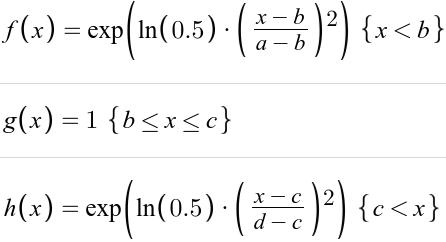
The function is parametrized by four numbers.
a: The young age the weight begins with 50%.
b: The young age the weight reaches 100%.
c: The old age the weight starts decreasing.
d: The old age the weight is reduced to 50%.
The concrete formula I have used is divided in three cases. (The interested reader can assert for themselves that this compound function is continuous and differentiable at the interval boundaries.)
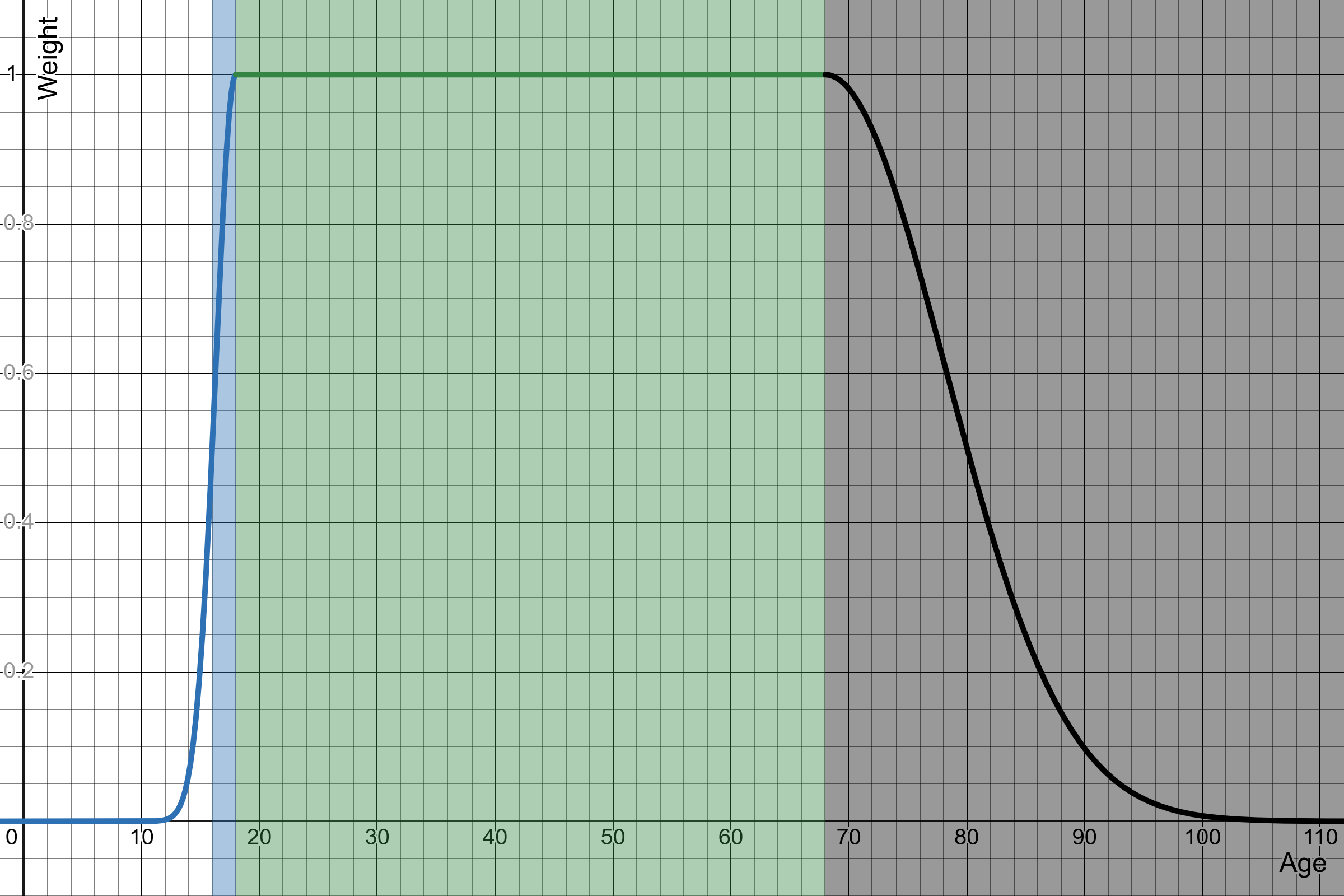
The opening image of this article shows a relative conservative instantiation with a=16, b=18, c=68, d=80 and I wonder if this is something most people would actually be ok with. It picks up the idea that those who have already lived the longest part of their life should not unduly determine the conditions of the lives of those who still have it ahead of them. On top of that, it acknowledges the demand that sixteen-year-olds should have the right to vote, with a compromise that makes their votes only count half as much as those of adults.
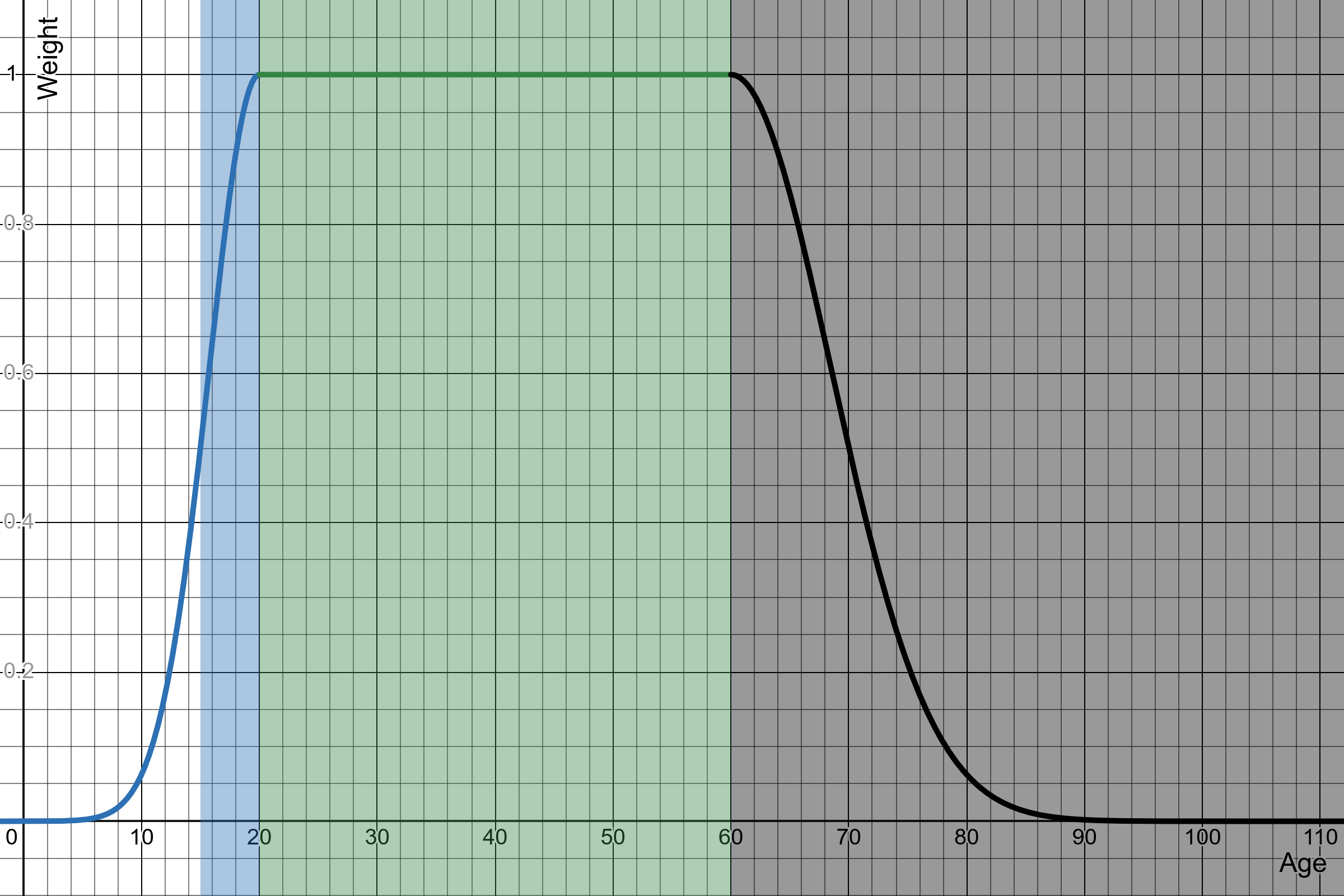
The image below shows an example that embraces the VWS a little more boldly (a=15, b=20, c=60, d=70). Compared to the other image, one can see how the “voting mass” is shifted to the left – i.e. younger ages – with a similar smooth climb and downslide.
Concluding Thoughts
Independent of the pros and cons of this idea, the VWS would not be easy to implement in practice. It would almost certainly need a digital voting system, which is a whole topic on its own. But if a solution were available where the birthday of the voter was known to the “vote evaluation machine”, the VWS would also address another issue with current voting regulations: Why is a person that turns 18 on election day allowed to vote but somebody who is just one day younger is not? With “day” as the temporal resolution of the system, instead of the commonly used “year”, both people in this example could be allowed to vote, with just a slightly different weight of their vote.
An interesting experiment would be: How would the outcome be if the VWS were put to the vote, once with the traditional equal-weights system, and once with the VWS system to be introduced. If the VWS system won in both elections, it could mean that people are not so egocentric after all, and the VWS might not even be needed. However, if the VWS system only won when already applied, this could be a hint that young people are indeed a little bit suppressed.
Finally one could ask if the idea of weighing votes differently could be applied to attributes other than age. Addressing the problem the world is facing, that there are not enough young people, should maybe the votes of women have a higher weight? After all, they are certainly the ones who would have to bear the babies. And the conditions for that, established by past and current politics, seem to be less than ideal. This could also be a compensation for when women did not have the right to vote at all.
In that regard, there were also societies where a citizen’s vote counted more if he paid more taxes. It would be interesting to see what the consequences would be if the vote weight were set to be inversely proportional to a person’s income. The idea being that the laws seem to be quite good already for those with high income. Maybe more people could get out of poverty if the poor had a stronger say in politics? In any case, the system would be self-balancing because if those with low income used their power to increase it, their vote weight would decrease accordingly. This way, maybe, the gap between rich and poor could shrink a little, instead of getting wider each year.